

Between Two Lives
On the eight months that changed everything, and the moment I stopped swimming back out.

There is a version of this story where I dramatically quit. Where I walked into my manager’s office on a Tuesday morning with my resignation letter already written, having made my decision cleanly and courageously, ready to announce the beginning of my new life.
That is not what happened.
What actually happened is quieter and messier and I think more honest, and probably more familiar to anyone who has ever stood at the edge of a life they weren’t sure they wanted anymore and had to figure out whether to jump or wait for the tide to make the decision for them.
I waited for the tide.
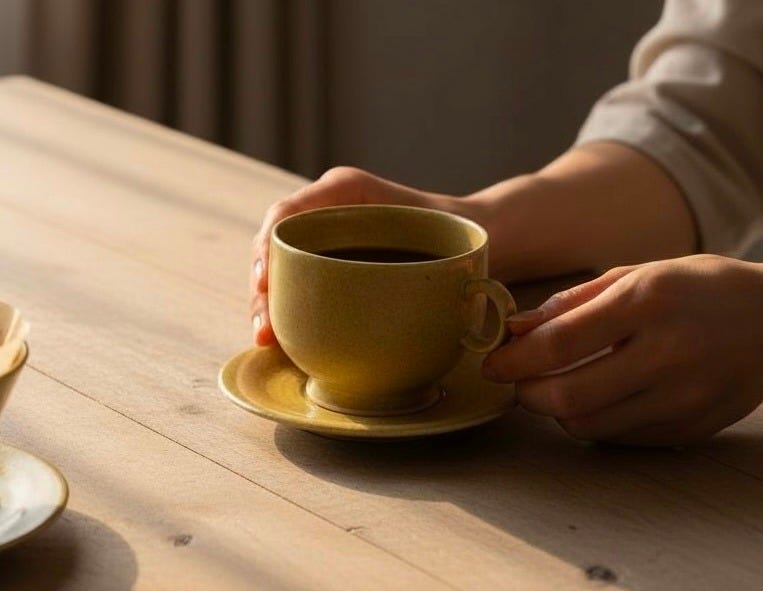
It started eight months before the end, though I didn’t know that’s what it was at the time. I had started going to the ceramics studio after work, just a few nights a week at first, then more. Five to nine, after nine to five. I would leave my desk, still carrying whatever the day had asked of me, drive to Mudflat, sit down at the wheel, and feel something in my body unknot that I hadn’t realized was clenched. The outside world stopped existing for a while. There was only the clay and my hands and the piece becoming itself beneath my fingers.
I barely stopped to eat. This is notable because eating is genuinely my love language.
At the time I told myself it was a hobby. A creative outlet. The thing that balanced out the spreadsheets and the Zoom calls and the corporate speak that made me want to rip my ears off by Thursday afternoon. I had developed a habit of pretending my camera was broken in meetings, sometimes my microphone too, just to get a few minutes of not having to hold my face in the right shape while my soul quietly left the building. I was getting through the days. The studio was where I went to actually live them.
But somewhere in those eight months, something shifted. I stopped thinking of the wheel as the thing I did after work and started thinking of work as the thing I did before the wheel. The order of importance had quietly reversed and I hadn’t announced it to anyone, including myself.
The company started slowing down before the official news came. There wasn’t much left to do. I could feel it the way you feel a wave starting to crest, that moment just before it breaks when everything goes still and you understand what’s about to happen. In mid-February the first round of layoffs hit. Colleagues I had worked alongside for years were suddenly out, and almost immediately a support chat appeared, full of people sharing job leads, company referrals, openings at places that were hiring in our field. Former managers sent me direct messages with roles on their new teams. I would love to have you, they said. And they meant it. These were good people who believed in me, who wanted good things for me, who were handing me the path forward with both hands.
I sat in that chat like a frog in slowly heating water, watching the links go by, and I knew.
I knew because I clicked on some of them. I went to the websites of the companies that were hiring. I read the job descriptions, and something happened in my body that I was not prepared for. I wanted to throw up. Not because the jobs were bad or the companies were wrong or the people offering them were anything other than kind. But because something in the shape of it, the language of it, the format of a life it was describing, felt like a door I had already walked through and closed behind me without realizing I had done it.
I still wanted to go back. Part of me did. I knew it was safe. I knew I was young and capable and that the path was right there, laid out so clearly by people who genuinely cared what happened to me. And there was this voice underneath everything asking who do I think I am? Who do I think I am to want something different at 25, to want to build something of my own when good people are out here working hard just to find their footing again? Why should I get to opt out of the search that everyone around me was doing?
But there was another voice. Quieter, steadier, more persistent. It said: if not now, when?
I was 25. No children, no pets, no one depending on my income but me. I had more energy and more freedom and fewer responsibilities than I would have at any point in the future, because that is simply how life works. Responsibilities accumulate. They add up over time until you look around one day and realize the window you were waiting for has been closed for years. I looked at the math of it and understood that waiting even a few more years meant waiting to live the life I actually wanted, and I could not find a good enough reason to do that.
So I stopped swimming back out.
I want to be honest about something, because I think it matters. I did not quit. I got furloughed at the end of March 2025, and I decided not to look for another job in the corporate world. When the official layoff came in June, I was already two months into building my first ceramics collection. I had already been through the grief of it, the identity shift of it, the terrifying and clarifying work of becoming someone whose hands were the point. The layoff was almost administrative at that point. A formality that matched a decision I had already made in private.
I am not going to pretend that is the same as walking away from a steady salary on a regular Tuesday. It is not. It is easier. The people who do that, who have a good job and a consistent paycheck and choose to leave anyway, who write the resignation letter and hand it in and watch the safety net disappear voluntarily, those people are doing something harder than what I did. I want to name that clearly because I think honesty about how we actually make our biggest decisions matters more than the cleaner story.
What I did was simpler and stranger. I just stopped opting in. I let the wave carry me to shore, and when I felt the sand under my feet I decided not to swim back out. I turned around and started walking inland instead, away from the water, away from the current that had been carrying me for years, toward something I could not yet see clearly but that felt, for the first time in a long time, like it might actually be mine.
The name of this publication is Somewhere to Land, this is the first essay in the paid version of this publication. I’ve been thinking about why that phrase feels so right, and I think it’s this.
Most of us are riding a wave we didn’t choose. Society hands it to you early, this is what success looks like, this is the current, stay on it, and so you paddle out and you catch it and you ride it because that’s what you’re supposed to do and honestly, it’s not bad out there. Some people feel genuinely called to the sea. Surfers live for that feeling, the power of it, the freedom of it, the way the ocean makes them feel alive. That life is real and it’s valid and it’s theirs.
But I kept waiting to feel called to it the way they did. And the call never came.
What I wanted was something steadier. Something I could plant my feet on. Something where I could carve my name into the land and say this is mine, and then spend the rest of my life exploring what that meant, going deeper instead of faster, building instead of just staying afloat.
The wave was always going to bring me here eventually. I just stopped swimming back out before it did.
Somewhere to Land is not about arrival. It’s about what happens when you finally stop letting the current decide where you go. It’s about the terrifying, unglamorous, deeply human work of walking inland and figuring out what you actually want to build.
I’m still walking. Come with me if you want to see where this goes.